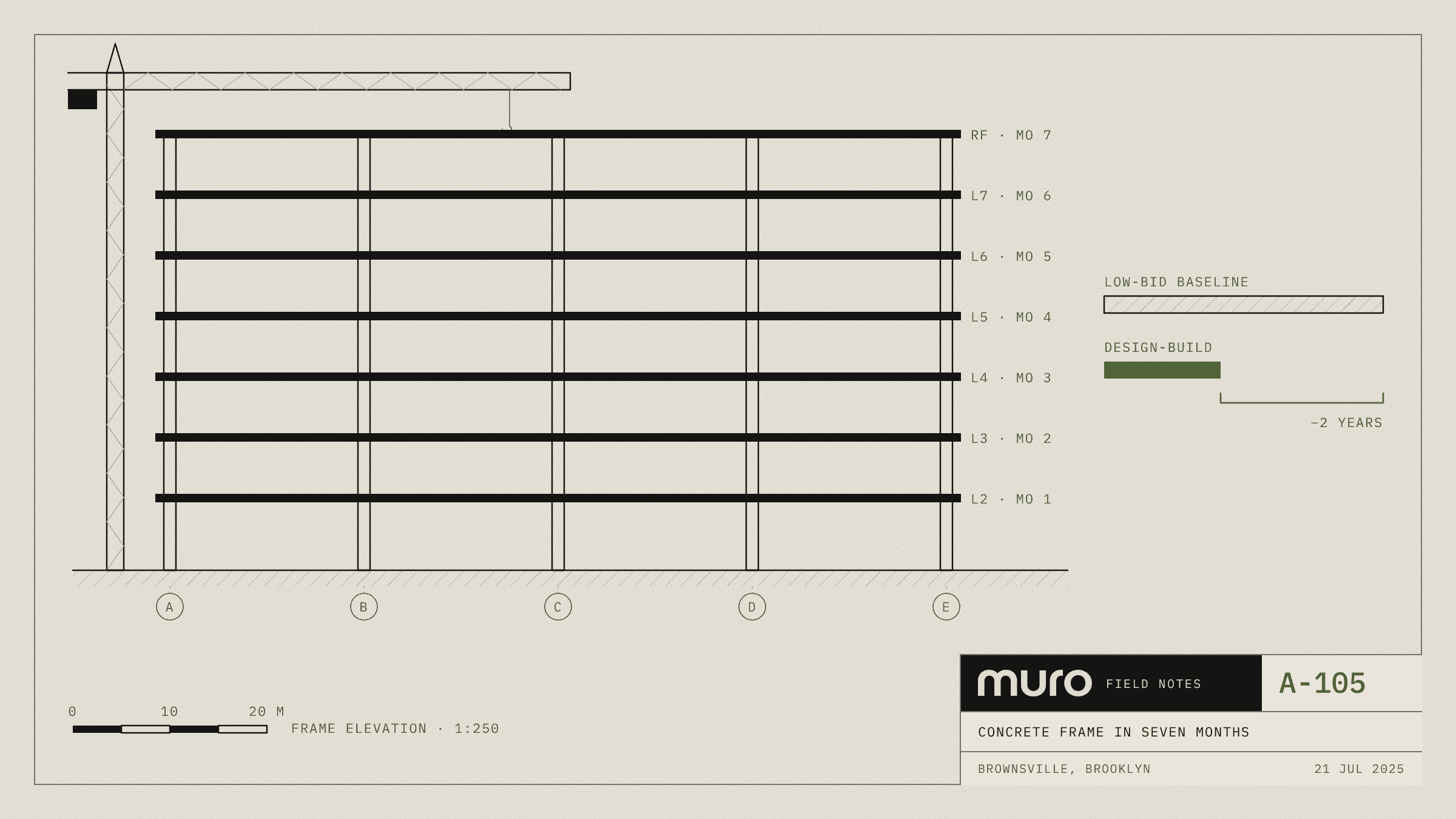
Speed and cost certainty come from integrating design, estimating and construction decisions up-front.
A November 2024 state bill expanded NYC’s authority to use progressive Design-Build and CM-Build, while the Mayor’s Capital Process Reform Task Force continues to push for wider adoption across NYCHA, H+H, DOT and other agencies.
The Design-Build Institute of America’s 2025 Sourcebook forecasts Design-Build accounting for nearly 50 % of all U.S. construction spend—$2.6 trillion—by 2028, delivering projects 102 % faster and with 3.8 % less cost growth.
Speed and cost certainty come from integrating design, estimating and construction decisions up-front. That front-loading shifts more risk-pricing, value-engineering and logistics modeling into the pre-con phase than ever before—leaving teams that still rely on manual take-offs and scattered spreadsheets exposed.
AI adoption is surging: 72 % of companies used AI in at least one business function in 2024, and the construction-specific AI market is projected to triple by 2029 (24 % CAGR). Design-Build projects amplify four AI sweet spots in pre-construction:
| AI capability | Why it matters in Design-Build | Example impact |
|---|---|---|
| Generative design & optioneering | Iterates structural systems, materials and MEP layouts to hit cost-per-sq-ft and Net-Zero targets before GMP lock-in | Faster value-engineering cycles; fewer RFIs down-stream |
| LLM-powered scope & quantity extraction | Creates reconciled scope books from drawings, specs and addenda for joint designer–builder teams | Removes weeks of duplicate take-offs; reduces change-order risk |
| Predictive cost & schedule analytics | Trains on historical DB projects to set realistic contingencies and phase-overlap logic | Early risk pricing builds owner trust; supports progressive GMP |
| Supply-chain & procurement intelligence | Monitors commodity indices and fabricator capacity to time early buy-outs | Shields teams from material escalation that can wipe out DB savings |
-
Mandate a shared data backbone early—structured drawings, 3D/BIM, and document repositories that AI agents can read instead of siloed PDFs.
-
Start with a high-ROI micro-workflow. Many owners pilot AI on quantity take-off or schedule-risk scoring before scaling to full “5-in-1” digital twins.
-
Link AI outputs to Design-Build commercial milestones. For example, feed AI-generated cost scenarios directly into progressive GMP negotiations.
-
Invest in human oversight. AI accelerates insight but still needs estimator, scheduler and VDC leads to validate outputs and champion adoption.
Policy makers are clearing the runway; Design-Build is accelerating; and owners are compressing schedules by years. AI-enabled pre-construction is the catalyst that keeps those promises solvent—turning faster procurement into reliably faster delivery. Teams that pair Design-Build contracts with AI-first pre-con processes will be the ones celebrating the next Brownsville-style milestone—only faster, and for less.